Warwick astronomers identify first credible green star, white dwarf WD J1330+6435
University of Warwick researchers say white dwarf WD J1330+6435 would look chartreuse green to the human eye, the first star credibly reported as green. Their wider study found white dwarfs can appear in many colours.

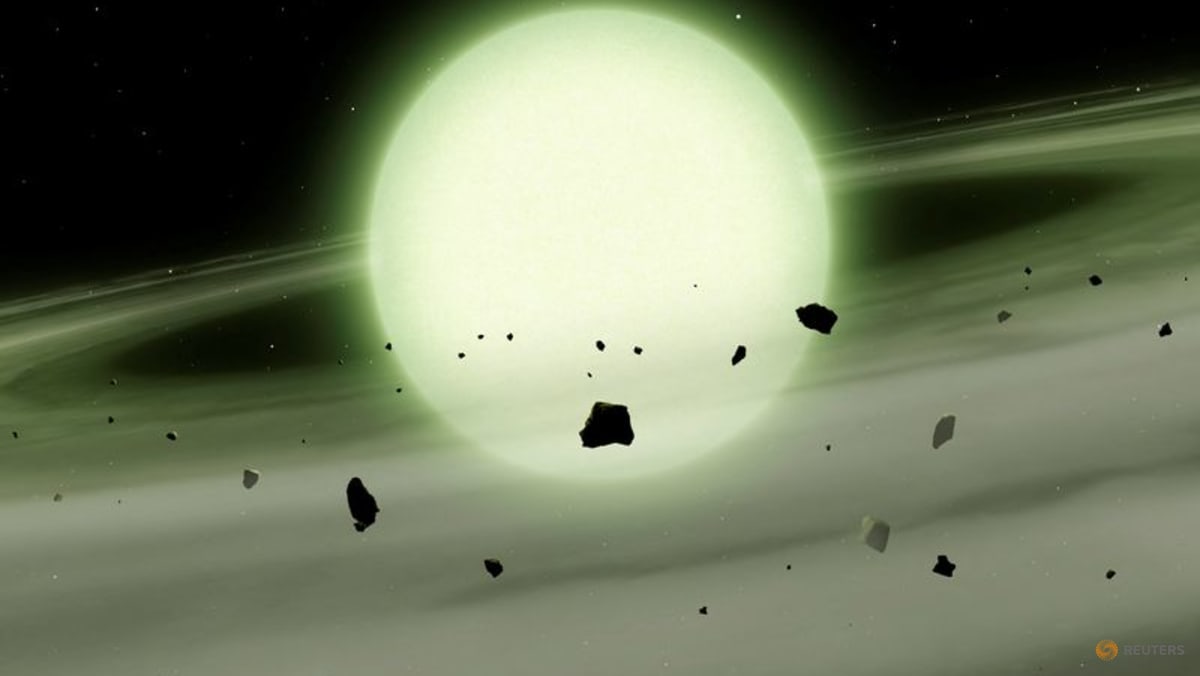
1 / 2
The story, neutrally told
Mixed · 2Astronomers at the University of Warwick have identified what they describe as the first credible green star: a white dwarf named WD J1330+6435. GB NewsR “Researchers at the University of Warwick have recorded a unique white dwarf star, named WD J1330+6435, which appears green to the human eye.” Read at GB News ↗ CNAN “Astronomers for the first time have identified a green star, documenting a dense stellar remnant called a white dwarf” Read at CNA ↗ Centre · 1CNA reports that the star lies about 280 light-years from Earth in the constellation Draco, and that the study was published in the journal RAS Techniques and Instruments. CNAN “is a white dwarf in the Milky Way galaxy that is located about 280 light-years from Earth in the constellation Draco.”“lead author of the study published in the journal RAS Techniques and Instruments.” Read at CNA ↗ Mixed · 2No white dwarf is close enough for its colour to be seen directly, so the team calculated the colours as human eyes would see them from spectra that astronomers already collect routinely, including Sloan Digital Sky Survey observations, and from white dwarf spectrum models they developed. GB NewsR “Although no white dwarf star is close enough for its colour to be seen directly, the team calculated it instead from data astronomers already collect routinely.” Read at GB News ↗ CNAN “Data used by the researchers included light spectrum observations from the Sloan Digital Sky Survey using a telescope in New Mexico” Read at CNA ↗
Mixed · 2Lead author Dr Mark Hollands said planetary material has fallen onto the star's surface, enriching its outer layers in calcium, lithium and especially sodium. CNAN “bits of planetary material have fallen onto its surface, enriching its outer layers in elements including calcium, lithium and, in particular, sodium” Read at CNA ↗ GB NewsR “The star is around 4,000C and has enriched its atmosphere with calcium, lithium, and sodium, giving it a chartreuse green appearance.” Read at GB News ↗ Mixed · 2Hollands explained that the star's density is so high that surrounding helium atoms constantly bombard the sodium atoms and alter their energy levels, so the sodium absorbs yellows, oranges and some reds rather than one narrow orange wavelength, leaving a chartreuse green glow. CNAN “they absorb the yellows, oranges and some of the red wavelengths. And what you're left with is a star that has a beautiful chartreuse green glow” Read at CNA ↗ GB NewsR “The traces of sodium in the atmosphere of this white dwarf absorb the orange part of the spectrum, leaving behind a ghostly green glow.” Read at GB News ↗ Right · 1GB News gives the star's temperature as around 4,000C and says that, as far as the Warwick astronomers are aware, no other star, living or dead, has been credibly reported as green. GB NewsR “As far as the Warwick astronomers are aware, no other star, living or dead, has ever been credibly reported as green” Read at GB News ↗
Mixed · 2Across the wider sample, the team found white dwarf colours fall into groups by atmospheric composition: carbon-rich stars are typically pink or purple, stars enriched with debris from shattered planetary systems lean yellow, and cooler stars with mixed hydrogen and helium atmospheres tend towards cyan or pale blue. CNAN “Carbon-rich white dwarfs usually were pink or purple. Those enriched with debris from shattered remnants of planetary systems leaned toward yellow.” Read at CNA ↗ GB NewsR “Cooler white dwarfs with mixed hydrogen and helium atmospheres often take on a cyan or pale blue tinge” Read at GB News ↗ Mixed · 2The researchers studied 151 white dwarfs within about 65 light-years of Earth; GB News says five showed unusual colouring (two yellow, three pink) and that the team concluded roughly one in 30 white dwarfs shine with unusual colour, while Professor Boris Gänsicke said the average white dwarf really is white. GB NewsR “five showed unusual colouring, two yellow and three pink.”“They concluded that roughly one in 30 white dwarfs in the Universe will shine with an unusually coloured light.” Read at GB News ↗ CNAN “The researchers studied 151 white dwarfs located within about 65 light-years of Earth, with white the average color.” Read at CNA ↗ Centre · 1CNA adds that one of the sample, WD J1011+2845, 48 light-years away in Leo Minor, showed perhaps the reddest hue of any known star, a salmon pink, caused by carbon from the star's deep interior rather than by an external impact. CNAN “One showed perhaps the reddest hue of any known star, a salmon pink. Named WD J1011+2845, it is located 48 light-years from Earth in the constellation Leo Minor.”“Rather than something hitting the star, in this case the carbon comes out from its deep interior” Read at CNA ↗
Every sentence links to the reporting it rests on. The pill in front of each says where its sources sit: Left, Centre or Right when one side supplies at least half of them, Mixed when they are evenly split. The number is how many outlets it cites.
Left0 outlets
No left outlet in our sources has covered this story yet.
Centre1 outlet
- Framing
- Wire-style science report explaining the physics of the discovery, with distance, location, journal and extended expert quotes.
- Emphasis
- Mechanism of colour (sodium and helium), location, journal, a salmon-pink second example, and a science-fiction comparison.
- Leaves out or plays down
- Does not give the star's temperature, nor the one-in-30 estimate.
- Charged language
- “ghostly shade of chartreuse”“leaves astronomers amazed”
Right1 outlet
- Framing
- Headline-led 'first ever green star in history' discovery story from a British university, stressing the novelty.
- Emphasis
- Superlative claim, the range of colours, and the one-in-30 oddly coloured fraction.
- Leaves out or plays down
- Omits the star's distance and constellation, the journal, and the helium-collision explanation.
- Charged language
- “first ever green star in history”“ghostly green glow”
What every side reports
- Warwick researchers identified white dwarf WD J1330+6435 as the first credibly green star.
- The green colour comes from sodium (with calcium and lithium) enriching its atmosphere.
- The team studied 151 white dwarfs within about 65 light-years of Earth.
- Carbon-rich white dwarfs tend pink or purple, debris-enriched ones yellow, and cooler mixed H/He ones cyan or pale blue.
- Mark Hollands led the work; Boris Gänsicke is a Warwick co-author.
Where accounts differ
-
How the sodium produces the green colour
- Centre
- CNA quotes Hollands saying helium atoms bombard sodium at high density, widening its absorption to yellows, oranges and some reds.
- Right
- GB News quotes Hollands saying sodium absorbs the orange part of the spectrum, without the helium mechanism.
University of Warwick organisation
Its researchers present the finding as the first credible green star, a result of a project to assess white dwarf colours as human eyes would see them.
“Most stars, including white dwarf stars, their colour is set almost entirely by temperature.” — GB News
“The discovery was part of a project assessing the color of white dwarfs as human eyes would see them.” — CNA
WD J1330+6435 other
The white dwarf is described as chartreuse green because sodium in its atmosphere absorbs orange and nearby wavelengths.
“what you're left with is a star that has a beautiful chartreuse green glow” — CNA
Left0 articles
No coverage yet.
Centre1 article
-
CNAN ·
Newly identified green star leaves astronomers amazed
Neutral Explanatory science report with detailed physics, locations and expert quotes.
Right1 article
-
GB NewsR ·
Astronomers at UK university discover first ever green star in history
Celebratory Presents the finding as a record-setting British science breakthrough with a sense of wonder.
- 15 Oct 14:32 First GB NewsR Astronomers at UK university discover first ever green star in history
- 16 Oct 10:02 +19h 31m CNAN Newly identified green star leaves astronomers amazed
Times are when each article was published, or when we first saw it if the outlet gave no time.
Ask about this story
Loading…