WTO raises 2026 goods trade forecast to 3.9% on AI demand, lowers services outlook
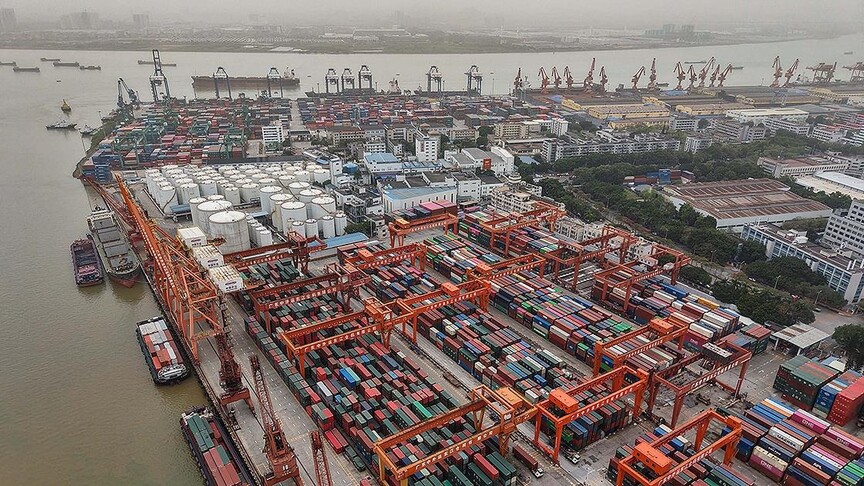
The WTO on 8 October raised its 2026 global merchandise trade growth forecast to 3.9% from 1.9%, citing AI-related investment and adaptable supply chains despite Middle East war disruption. It cut its services trade projection.
1 / 2
The story, neutrally told
Centre · 2The World Trade Organization said on Thursday 8 October that it now expects global merchandise trade volumes to grow 3.9% in 2026, up from the 1.9% it forecast in March. Anadolu AgencyN “raised its forecast for global goods trade growth this year to 3.9% from 1.9%” Read at Anadolu Agency ↗ CNAN “now projects 3.9 per cent growth in the volume of merchandise trade this year, up from 1.9 per cent predicted in March” Read at CNA ↗ Centre · 2It lowered its services trade growth projection for 2026 to 3.3% from 4.8% in March; CNA says services growth is still expected to remain positive. Anadolu AgencyN “lowered its services trade growth projection to 3.3% from the 4.8% forecast in March” Read at Anadolu Agency ↗ CNAN “WTO economists have lowered their forecasts for trade in services, though growth is nonetheless expected to remain positive.” Read at CNA ↗ Centre · 2Merchandise trade grew 3.5% in the first half of 2026, more than the WTO had expected, even with shocks to energy, fertiliser and transport markets from the Middle East war and disruption to shipping through the Strait of Hormuz. Anadolu AgencyN “Global merchandise trade volumes expanded 3.5% in the first half of 2026, exceeding expectations” Read at Anadolu Agency ↗ CNAN “disruptions of shipments through the Strait of Hormuz had reduced energy supplies and raised prices of key energy products and fertilisers” Read at CNA ↗
Centre · 2The WTO attributed the resilience to AI investment and to supply chains that adapted with alternative suppliers and routes: trade in AI-enabling goods such as semiconductors and servers rose 67% year-on-year in the first half and made up 47% of merchandise trade growth. Anadolu AgencyN “surged 67% year-on-year, accounting for 47% of global merchandise trade growth during the period” Read at Anadolu Agency ↗ CNAN “strong demand linked to AI investment "more than offset the negative effects" of the conflict” Read at CNA ↗ Centre · 2Middle Eastern crude oil exports fell about 24% year-on-year in the first half and LNG exports 47%, but other suppliers limited the fall in global exports to about 6% for crude and 1% for LNG; global container throughput rose 3.9% over the first seven months of the year. Anadolu AgencyN “Middle Eastern crude oil exports fell about 24% year-on-year in the first half, while liquefied natural gas exports dropped 47%.” Read at Anadolu Agency ↗ CNAN “global container traffic actually increased by 3.9 per cent during the first seven months of 2026” Read at CNA ↗ Centre · 2For 2027 the WTO forecasts merchandise trade growth of 4.1% (up from 2.6% predicted in March) and services growth of 6.4%; it expects global GDP to grow 2.6% in 2026 and 2.9% in 2027. Anadolu AgencyN “The WTO expects merchandise trade to grow 4.1% in 2027, with services trade expanding 6.4%.” Read at Anadolu Agency ↗ CNAN “Global GDP is expected to grow by 2.6 per cent this year and 2.9 per cent in 2027” Read at CNA ↗
Centre · 1By region, Asia is projected to have the fastest merchandise export growth in 2026 (9.9%), followed by North America (5.7%), while Europe's is forecast down 0.1% and the Middle East's down 17.2%. CNAN “Asia is expected to record the fastest merchandise export growth (9.9 per cent), followed by North America (5.7 per cent).” Read at CNA ↗ Centre · 2The WTO stressed that gains are uneven: AI-goods supply is concentrated in a few East and Southeast Asian economies while North America drives demand, and services and some regions are more exposed to the conflict. CNAN “a small number of East and Southeast Asian economies supply these goods, while North America is driving demand” Read at CNA ↗ Anadolu AgencyN “services trade and some regions more exposed to the conflict” Read at Anadolu Agency ↗ Centre · 2Director-General Ngozi Okonjo-Iweala said the numbers showed "trade resilience in action" and that an integrated economy and rules-based system let economies keep essential goods flowing, but that some felt the shock more and not everyone can access opportunities like AI. CNAN “"The numbers reflect trade resilience in action," said WTO chief Ngozi Okonjo-Iweala.” Read at CNA ↗ Anadolu AgencyN “access to emerging opportunities such as AI remained unequal, she said” Read at Anadolu Agency ↗
Centre · 1Chief economist Robert Staiger said the WTO was "surprised" by both the limited hit from the conflict and the strength of the AI boom, and warned that any slowdown in AI investment could precipitate a trade slowdown; AI infrastructure spending is expected to rise at least 30% this year and a further 10-20% in 2027. CNAN “But any slowdown in AI investment could precipitate a slowdown in trade," he warned.”“Global spending on AI infrastructure is expected to rise at least 30 per cent this year” Read at CNA ↗
Every sentence links to the reporting it rests on. The pill in front of each says where its sources sit: Left, Centre or Right when one side supplies at least half of them, Mixed when they are evenly split. The number is how many outlets it cites.
Left0 outlets
No left outlet in our sources has covered this story yet.
Centre2 outlets
- Framing
- Both outlets report the WTO's Global Trade Outlook as a resilience story: AI-driven goods trade and adapted supply chains offset the Middle East war, with uneven gains. Anadolu headlines the services downgrade; CNA leads on the AI boom.
- Emphasis
- Anadolu stresses the services cut and Middle East energy export falls; CNA adds regional export forecasts, GDP figures and the chief economist's warning about AI dependence.
- Leaves out or plays down
- Anadolu omits regional export forecasts, GDP projections and Staiger's warning. CNA omits the 3.3% and 4.8% services figures and the Middle East's 24% crude and 47% LNG export falls.
- Charged language
- “sharply raised”“AI boom”
- For example
-
“WTO raises 2026 goods trade growth forecast to 3.9%, cuts services outlook” — Anadolu Agency
“WTO hikes 2026 trade growth forecast on AI boom” — CNA
Right0 outlets
No right outlet in our sources has covered this story yet.
What every side reports
- WTO raised its 2026 merchandise trade growth forecast to 3.9% from 1.9%.
- Merchandise trade grew 3.5% in the first half of 2026.
- AI-enabling goods trade rose 67% and made up 47% of merchandise trade growth.
- The WTO forecasts 4.1% merchandise trade growth in 2027.
- Okonjo-Iweala said some economies felt the shock more than others and AI access is unequal.
Where accounts differ
-
Global crude oil and LNG export declines
- Centre
- Anadolu says Middle Eastern crude exports fell about 24% and LNG 47%, with global exports down 6% for crude and 1% for LNG; CNA gives only the global figures.
World Trade Organization organisation
The WTO presents the upgrade as evidence of trade resilience and rules-based system flexibility, while warning of uneven gains, weaker services, and dependence on continued AI investment.
“"The numbers reflect trade resilience in action," said WTO chief Ngozi Okonjo-Iweala.” — CNA
“But any slowdown in AI investment could precipitate a slowdown in trade," he warned.” — CNA
Left0 articles
No coverage yet.
Centre2 articles
-
WTO raises 2026 goods trade growth forecast to 3.9%, cuts services outlook
Neutral Concise report of the WTO figures, giving both the goods upgrade and services cut and the Middle East energy export declines.
-
CNAN ·
WTO hikes 2026 trade growth forecast on AI boom
Neutral Fuller account led by the AI boom, with regional forecasts and the chief economist's caution.
Right0 articles
No coverage yet.
- 8 Oct 14:26 First Anadolu AgencyN WTO raises 2026 goods trade growth forecast to 3.9%, cuts services outlook
- 8 Oct 17:56 +3h 30m CNAN WTO hikes 2026 trade growth forecast on AI boom
Times are when each article was published, or when we first saw it if the outlet gave no time.