Xi'an court settles neighbours' boundary dispute traced to an 1781 deed
A court in Xi'an's Yanta district heard a boundary dispute between the Du and Zhang families. A Qing-era deed dated 1781 suggested the quarrel was over 200 years old. The case was resolved with a renovation plan, and it went viral online.
1 / 1
The story, neutrally told
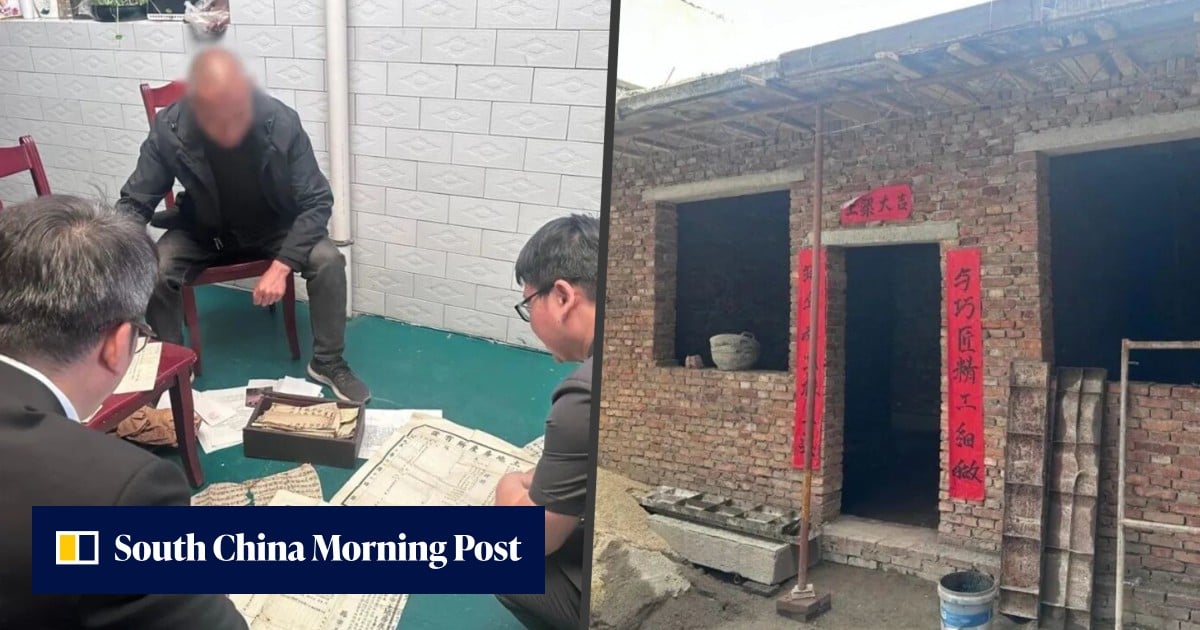
Centre · 2A court in Yanta district, Xi'an, in Shaanxi province, northwestern China, recently heard a land boundary case between two neighbouring families surnamed Du and Zhang. South China Morning PostN “The court in Yanta district, Xian, in northwestern China’s Shaanxi province, recently presided over a case concerning a land boundary between two neighbouring families, surnamed Du and Zhang.” Read at South China Morning Post ↗ Hindustan TimesN “The case, involving two families surnamed Du and Zhang, was recently heard by a court in northwestern China’s Shaanxi province” Read at Hindustan Times ↗ Centre · 1The families had repeatedly disputed the boundary for about two decades. The row began when the Dus tried to renovate their kitchen and raise a wall, and the Zhangs objected, citing light and drainage. South China Morning PostN “When the Dus tried to renovate their kitchen and raise a wall, the Zhangs repeatedly objected, citing concerns about light and drainage.” Read at South China Morning Post ↗ Centre · 2The disagreement led to frequent verbal and physical clashes. Police and the village committee mediated dozens of times without resolving it. South China Morning PostN “The police and the village committee tried to mediate dozens of times, but the deadlock remained unresolved.” Read at South China Morning Post ↗ Hindustan TimesN “The dispute eventually led to frequent verbal and physical confrontations” Read at Hindustan Times ↗
Centre · 2At one mediation session the Zhangs produced a yellowed, torn land deed from the 46th year of the Qianlong Emperor's reign (1781), in the Qing dynasty. Its handwriting was still legible. South China Morning PostN “On the yellowed, torn page, the well-preserved handwritten ink was still clearly legible.” Read at South China Morning Post ↗ Hindustan TimesN “The document, which dates to 1781, reportedly contained an agreement between the families establishing the boundary between their properties” Read at Hindustan Times ↗ Centre · 2Zhang said the deed was an agreement between the families that set the boundary, marked by a persimmon tree in the courtyard. The Zhangs believed future generations should honour it. South China Morning PostN “marked by a persimmon tree in the courtyard” Read at South China Morning Post ↗ Hindustan TimesN “The Zhang family maintained that the old agreement should be respected by future generations.” Read at Hindustan Times ↗ Centre · 1Authorities concluded that the families' quarrel had lasted more than 200 years. Successive generations had clashed over the boundary, including once shortly after the People's Republic of China was founded in 1949. South China Morning PostN “Over the past two centuries, successive generations of the families had repeatedly clashed over the boundary, including once shortly after the People’s Republic of China was founded in 1949.” Read at South China Morning Post ↗
Centre · 2The court did not decide the boundary on the deed alone. It also drew on a letter from the Qing scholar and politician Zhang Ying, who urged his family to yield ground to a neighbour: "A letter from afar just for a wall, why not give up three feet? The Great Wall still stands today, but Qin Shi Huang is nowhere to be seen." South China Morning PostN “But the court did not determine the boundary between the two households solely on the basis of the 1781 deed.” Read at South China Morning Post ↗ Hindustan TimesN “Instead, authorities also drew inspiration from a famous letter written by Zhang Ying” Read at Hindustan Times ↗ Centre · 2By the account of that story, Zhang Ying's family moved their wall back three feet and the neighbour did the same, forming a six-foot-wide lane. The lane is now a tourist attraction in Tongcheng, Anhui province. South China Morning PostN “The two walls then formed a six-foot-wide lane, which is now a tourist attraction in Tongcheng, in central China’s Anhui province.” Read at South China Morning Post ↗ Hindustan TimesN “is remembered as a symbol of compromise and neighbourly harmony” Read at Hindustan Times ↗ Centre · 2Authorities took repeated measurements at both homes and drew up a renovation plan meant to satisfy both families. The Dus then renovated their kitchen, and the Zhangs accepted the outcome peacefully. South China Morning PostN “Eventually, the Dus successfully renovated their kitchen, and the Zhangs accepted the outcome peacefully.” Read at South China Morning Post ↗ Hindustan TimesN “authorities carried out repeated measurements at the properties and developed a renovation plan intended to address both families’ concerns” Read at Hindustan Times ↗
Centre · 2The case went viral on social media. One user wrote, "Love cannot last for 200 years, but lawsuits can." Another joked that the land must have very good feng shui. South China Morning PostN ““Love cannot last for 200 years, but lawsuits can,” one online observer remarked.” Read at South China Morning Post ↗ Hindustan TimesN “The unusual case has drawn attention online, with social media users commenting on the extraordinary length of the disagreement.” Read at Hindustan Times ↗
Every sentence links to the reporting it rests on. The pill in front of each says where its sources sit: Left, Centre or Right when one side supplies at least half of them, Mixed when they are evenly split. The number is how many outlets it cites.
Left0 outlets
No left outlet in our sources has covered this story yet.
Centre2 outlets
- Framing
- Both outlets tell the story as a light, viral human-interest item. The Hindustan Times account is based on the South China Morning Post's report.
- Emphasis
- The 1781 deed, the 200-year span, the Zhang Ying letter and the peaceful outcome, plus online reactions.
- Leaves out or plays down
- Neither names the court's formal ruling, the date of the hearing, or any source other than the families' account and the court. Neither gives a named official or court statement.
- Charged language
- “stunning social media users”“astonished everyone”
- For example
-
“stunning social media users” — South China Morning Post
“astonishing those present and revealing the dispute’s extraordinary history” — Hindustan Times
Right0 outlets
No right outlet in our sources has covered this story yet.
What every side reports
- The case involved the Du and Zhang families in Shaanxi province, northwestern China.
- The Zhangs produced a land deed from the 46th year of Qianlong's reign (1781).
- The court did not rely solely on the deed and cited a letter by Zhang Ying.
- The Dus were able to renovate their kitchen and the Zhangs accepted the outcome.
East and Southeast Asia1 outlet
The SCMP originates the report and treats it as a trending China story.
“A Chinese court recently heard a land dispute between neighbours” — South China Morning Post
South China Morning Post
South Asia1 outlet
The Hindustan Times repackages the SCMP report, attributes it to the SCMP and adds more hedging.
“as per a report by the South China Morning Post” — Hindustan Times
Hindustan Times
Left0 articles
No coverage yet.
Centre2 articles
-
Chinese neighbours go viral over 200-year land dispute dating back to Qianlong era
Neutral Trending-China piece presenting the case as a viral curiosity, with a Qing-era anecdote and online quips.
-
Chinese neighbours fight over land for 200 years, 1781 deed emerges in court
Neutral Rewrite of the SCMP report that stresses the deed's discovery and the symbol of compromise; hedges with 'reportedly'.
Right0 articles
No coverage yet.
- 26 Oct 02:00 First South China Morning PostN Chinese neighbours go viral over 200-year land dispute dating back to Qianlong era
- 26 Oct 13:44 +11h 44m Hindustan TimesN Chinese neighbours fight over land for 200 years, 1781 deed emerges in court
Times are when each article was published, or when we first saw it if the outlet gave no time.
Ask about this story
Loading…